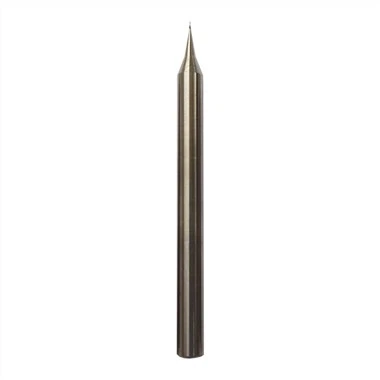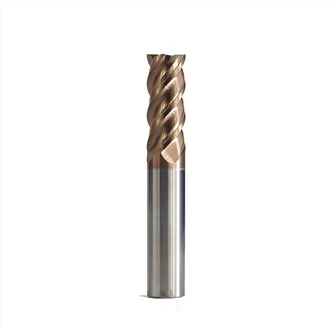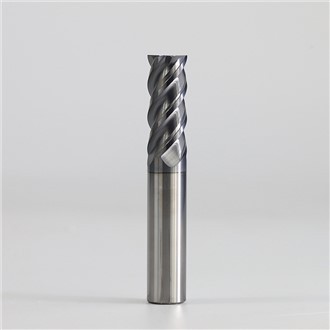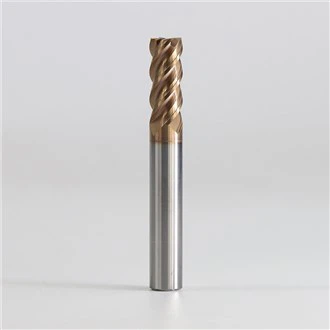
In addition to end mills and some end mills and cemented carbide as milling cutter materials for milling stainless steel, other types of milling cutters are made of high-speed steel, especially tungsten-molybdenum and high-vanadium high-speed steel, which have good results. Durability can be increased by 1 to 2 times compared to W18Cr4V. Carbide grades suitable for making stainless steel milling cutters are YG8, YW2, 813, 798, YS2T, YS30, YS25, etc.
The spray cooling method has the most significant effect, which can increase the durability of the milling cutter by more than one time; if the general 10% emulsion is used for cooling, the flow rate of the cutting fluid should be fully cooled. When milling stainless steel with carbide milling cutter, take Vc=70~150m/min, Vf=37.5~150mm/min, and make appropriate adjustments according to the alloy grade and workpiece material.
The adhesion and fusion of stainless steel are strong, and the chips are easy to adhere to the cutting edge of the milling cutter, which deteriorates the cutting conditions; during up milling, the cutting edge slides on the hardened surface first, which increases the tendency of work hardening; impact during milling , The vibration is large, which makes the milling cutter blade easy to chip and wear.
When milling stainless steel, the cutting edge must be both sharp and shock-resistant, and the chip flute must be large. Large helix angle milling cutters (cylindrical milling cutters, end milling cutters) can be used, the helix angle b is increased from 20° to 45° (gn=5°), and the tool durability can be increased by more than 2 times, because at this time the work of the milling cutter The rake angle g0e is increased from 11° to more than 27°, and milling is brisk. However, the b value should not be too large, especially for end mills with b≤35°, so as not to weaken the teeth.
The corrugated edge end mill is used to process stainless steel pipes or thin-walled parts, which has the advantages of light cutting, small vibration, fragile chips, and no deformation of the workpiece. High-speed milling with carbide end mills and indexable end mills in stainless steel can achieve good results.
Milling 1Cr18Ni9Ti with silver chip end mill, its geometric parameters are gf=5°, gp=15°, af=15°, ap=5°, kr=55°, k′r=35°, g01=-30° , bg=0.4mm, re=6mm, when Vc=50~90m/min, Vf=630~750mm/min, a′p=2~6mm and the feed per tooth reaches 0.4~0.8mm, the milling force decreases It is 10% to 15% smaller, the milling power is reduced by 44%, and the efficiency is also greatly improved. The principle is to grind a negative chamfer on the main cutting edge, and artificially generate a built-up edge during milling, so that it can replace the cutting edge for cutting. As a result, the built-up edge is subjected to a thrust parallel to the cutting edge generated by a rake face and becomes secondary chips outflow, thereby taking away the cutting heat and reducing the cutting temperature.
When milling stainless steel, climb milling should be used as much as possible. The asymmetric climb milling method can ensure that the cutting edge is smoothly cut away from the metal, the chip bonding contact area is small, and it is easy to be thrown off under the action of high-speed centrifugal force, so as to prevent the chip from impacting the rake face when the cutter teeth re-cut into the workpiece. Peeling and chipping phenomenon, improve the durability of the tool.
Stainless steel materials are widely used, and can be encountered in turning, milling, drilling, and tapping. But because stainless steel has different characteristics from other general materials, machining stainless steel has become a big problem for technicians!